

Over 30 years of anarchist writing from Ireland listed under hundreds of topics
This is a series explaining the 9 Points of Unity of the Workers Solidarity Movement - an anarchist organisation active on the island of Ireland. [Download PDF of these explanations]
The WSM regularly discusses, debates and decides on what our collective political approach is. The Points of Unity are the most basic political agreement necessary to be a WSM member or supporter. They are 9 short points which outline the anarchism the WSM stands for.
'7. We actively oppose all manifestations of prejudice within the workers' movement and society in general and we work alongside those struggling against racism, sexism, [religious] sectarianism and homophobia as a priority. We see the success of a revolution and the successful elimination of these oppressions after the revolution being determined by the building of such struggles in the pre-revolutionary period. The methods of struggle that we promote are a preparation for the running of society along anarchist and communist lines after the revolution.'
Human beings are complex. We have many sides, many needs, wishes, strengths and weaknesses, many different obstacles and opportunities in life. So while acknowledging the huge harm caused by capitalism and the state, our concerns naturally do not end there. The Workers Solidarity Movement are anarchists because we want the total liberation of humankind, the full realisation of our need and wish to fed, sheltered, clothed, respected, in charge of ourselves, within a real community, to be our true selves, and the rest of the rich tapestry which makes a good life. And so we recognise that patriarchy, racism, queerphobia, ableism, religious domination and sectarianism, xenophobia, and every way that joy is sucked out of our lives, that we are stifled, attacked, are important forms of oppression and marginalisation in their own right which must be eradicated. While capitalism and the state are instrumental in spreading these oppressions, and while these oppressions are instrumental in sustaining capitalism and the state, they have their own independent existence and reasons to be replaced by healthier relations between people.
 We don’t understand words as simply words on their own, entirely dependent on their definition, as one word can have many different meanings. Context plays a big part in our understanding of words. There are some words that leave context with the responsibility of our understanding of what has just been said. The word “buckle”, for example, can either mean “to connect” or “to collapse”, two meanings opposite to each other, leaving us in need of context in order to understand the usage of the word.
What is this?
This paper outlines how we the intersections of exploitation and oppressions and what approach the WSM takes in relation to this. Our collective theoretical understanding is framed in the WSM Constitution’s core point of unity number 7: “We actively oppose all manifestations of prejudice within the workers' movement and society in general and we work alongside those struggling against racism, sexism, [religious] sectarianism and homophobia as a priority. We see the success of a revolution and the successful elimination of these oppressions after the revolution being determined by the building of such struggles in the pre-revolutionary period. The methods of struggle that we promote are a preparation for the running of society along anarchist and communist lines after the revolution.”
That theory is informed by the individual and collective experiences of WSM members over 30 years and our adaption of anarchism to our local contexts which includes specific experiences of oppression and personal & historical experiences of the anti-colonial struggle in Ireland and elsewhere. The development of this paper involved our own experiences being placed alongside our discussions of the broad set of writings and observations emerging from the anarchist and feminist study of the relationship between gender, class and race and in particular what is often referred to today as ‘Intersectionality’.
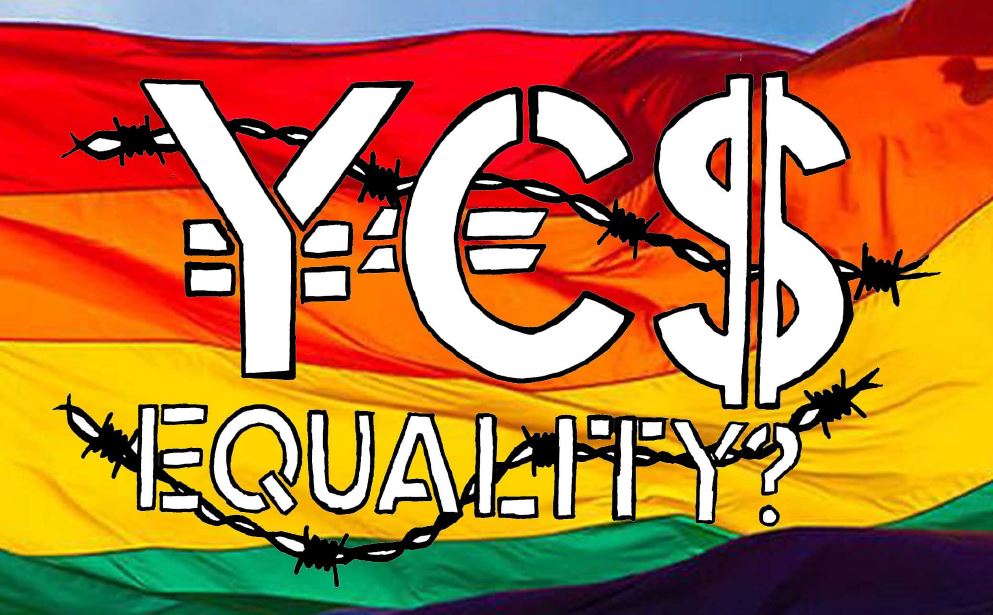
I had mixed feelings attending Pride, but mostly felt bewildered and pissed off. I was looking forward to this year's Pride for quite some time. It was my second ever Pride, and I came to march with the Radical Left Bloc, one of two radical blocs attending, which was organised by others. Like last year, I was shocked – somehow again – by the level of corporate infestation and toothlessness.
Here is an important question for everyone: what's the point of Pride? From being there, I know clearly that people's answers to this question vary hugely.
 Our hearts ache for the victims of the homophobic hate crime that took place over the weekend in Orlando, Florida where a gunman attacked an LGBT+ club killing 50 and wounding over 50 more. Much has been asked by us and by other left queers about the LGBT+ community, whether it exists and if it exists why don’t we feel a part of it. Sadly it is at times like these that we become aware of its existence. When people are considered deviants and deserving of a murderous assault for their sexuality, a trait all of us in the community share, we cannot but come together in sadness and in mourning.
 Anarchism can learn a lot from the feminist movement. In many respects it already has. Anarcha-feminists have developed analyses of patriarchy that link it to the state form. We have learned from the slogan that "the personal is political" (e.g. men who espouse equality between all genders should treat the women in their lives with dignity and respect). We have learned that no revolutionary project can be complete while men systematically dominate and exploit women; that socialism is a rather empty goal--even if it is "stateless"--if men's domination of women is left intact.
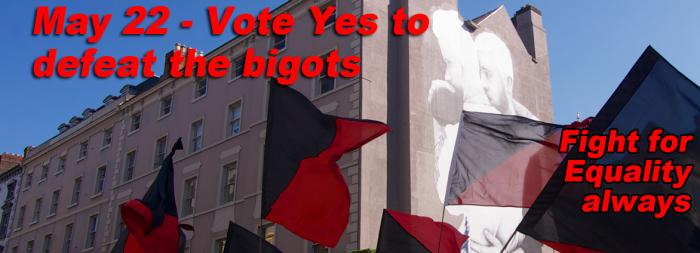
May 22nd offers an opportunity for many of us in Ireland to strike a blow against homophobia in voting for Marriage equality.
We find ourselves in Ireland facing a imminent referendum on marriage equality, which the hardline religious right are opposing as part of their program of maintaining multiple oppressions.
A No vote in that context would be disastrous, serving only to entrench homophobia. Therefore anarchists are campaigning for a Yes to Marriage Equality vote but beyond the need to ensure the referendum is not defeated this session of the 2015 Dublin Anarchist Bookfair asked what else needed to be said?
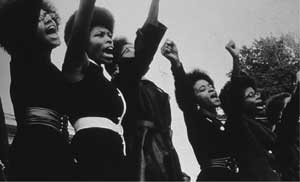 As class-struggle anarchists dealing with the relations between gender, race and class, we must, in theory and practice, pick a path between two pitfalls. On one side is economic reductionism – the reduction of all political questions to the social relations of production – which erases the perspectives and struggles of women, queers and people of colour; submerges their voices within an overly generalised class narrative, in which the idealised Worker is implicitly white heterosexual and male; or consigns their struggles to a secondary importance compared to the “real struggle” of (economic) class against class. On the other is a stultifying and inward-looking liberal-idealist identity politics, concerned fetishistically with the identification of privilege and the self-regulation of individual oppressive behaviour to the (near) exclusion of organised struggle, which, while amplifying the voices of the marginalised, consigns them to an echo chamber where they can resonate harmlessly.
