

Over 30 years of anarchist writing from Ireland listed under hundreds of topics
This is a series explaining the 9 Points of Unity of the Workers Solidarity Movement - an anarchist organisation active on the island of Ireland. [Download PDF of these explanations]
The WSM regularly discusses, debates and decides on what our collective political approach is. The Points of Unity are the most basic political agreement necessary to be a WSM member or supporter. They are 9 short points which outline the anarchism the WSM stands for.
There’s not enough bloody time in the day. I find the more my life goes on, the less time I have to live. I wake up around 6am to go to work, and after my commute home, cooking dinner, and attending to other errands, I have 1 hour to myself if I’m lucky. Often by the time I do these basic tasks it’s late enough that I know I’ll be shattered tomorrow and I’ll have to drag myself through the day. After five days I clamber to the shore of the weekend, but often find I’m so drained and conditioned by the work week I’m not myself. It’s a cycle which has no end in sight. Time is constantly on my mind. ‘Can’t do that, not enough time. Sorry, not enough time. Not enough time. I wish I had more time. Where does the time go?’ Checking my phone, what time is it, checking my phone, checking my phone. It does my head in and it’s not going to improve.
'1. Anarchism will be created by the class struggle between the vast majority of society (the working class) and the tiny minority that currently rule. A successful revolution will require that anarchist ideas become the leading ideas within the working class. This will not happen spontaneously. Our role is to make anarchist ideas the leading ideas or, as it is sometimes expressed, to become a ''leadership of ideas''.’
We're usually told that class society is a thing of the past. After all, aren't we all middle class now? But this isn't true, and there still very much exists a severe division between people based on property and work, a hierarchy which is a basic fact of the economic system known as capitalism.
'5. A major focus of our activity is our work within the economic organisations of the working class (labour organisations, trade unions, syndicates) where this is a possibility. We therefore reject views that dismiss activity in the unions because as members of the working class it is only natural that we should also be members of these mass organisations. Within them we fight for the democratic structures typical of anarcho-syndicalist unions like the 1930's CNT. However, the unions no matter how revolutionary cannot replace the need for anarchist political organisation(s).'
Throughout history the trade union movement has been a vitally important mass movement. In the face of bitter hardship and repression - even state murder - the downtrodden have banded together and demanded more, driving society forwards in the process. For instance, in Ireland we can thank the union movement for the end of child labour and for the 'weekend'. However, unions are not a relic for museums. Recent victories for better conditions and pay are a practical proof of that, not to mention participation of some fairly large unions in wider grassroots political campaigns. In spite of the relative decline of trade unions in the past neoliberal decades, their role today is still greatly important, as long as there are zero-hour contracts, wage cuts, pay freezes, lay-offs, unpaid overtime, long days, workplace bullying, and capitalism itself.
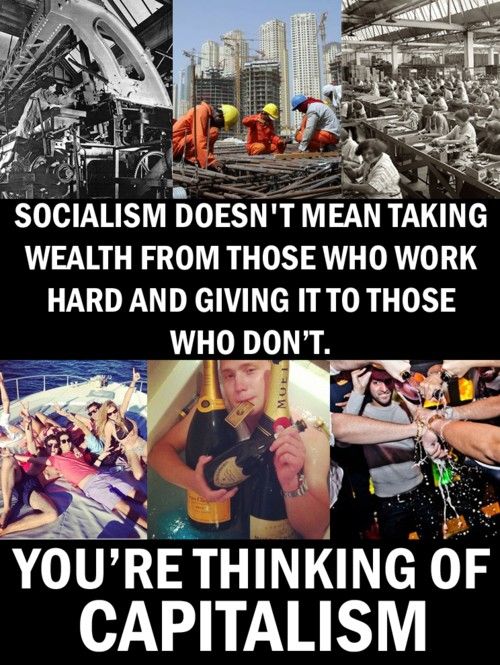 One of the most common arguments against the establishment of Anarchist Socialism is that there would be no incentive to work in a new, future society - leading to widespread apathy and laziness among the general population, with a few carrying the burden of the overwhelming majority at best and at worst nothing will be done at all. The aim of this piece is to highlight that the opposite is instead true - that in a socialist society there will even more of an incentive to work productively (in the capitalist sense) and to contribute to the communal pot which we can all then draw from.
Firstly we should reject the capitalist ethos of what is productive labour. To summarise under capitalism productive labour is valued by how much profit can be made in a transaction of goods, services or ficticous capital - not by how valuable it is on a human level. Take for instance stock brokers who get enormous pay checks for betting on and moving currency or goods around the world, while mothers and the care givers of children get next to nothing, becoming slaves to charity, the state or their partners (possible all of these) to support them in the rearing and socialisation of children, so arguably one of the most important jobs in society gets no remuneration.
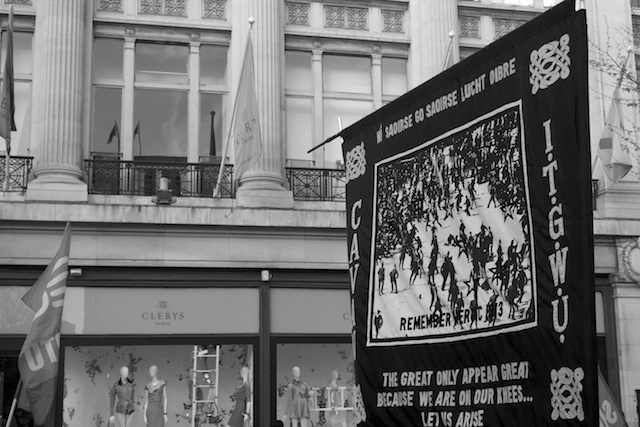 The 1913 lockout occurred when the Dublin bosses under William Martin Murphy tried to destroy the syndicalist ITGUW by locking out all workers who refused to resign from the union.
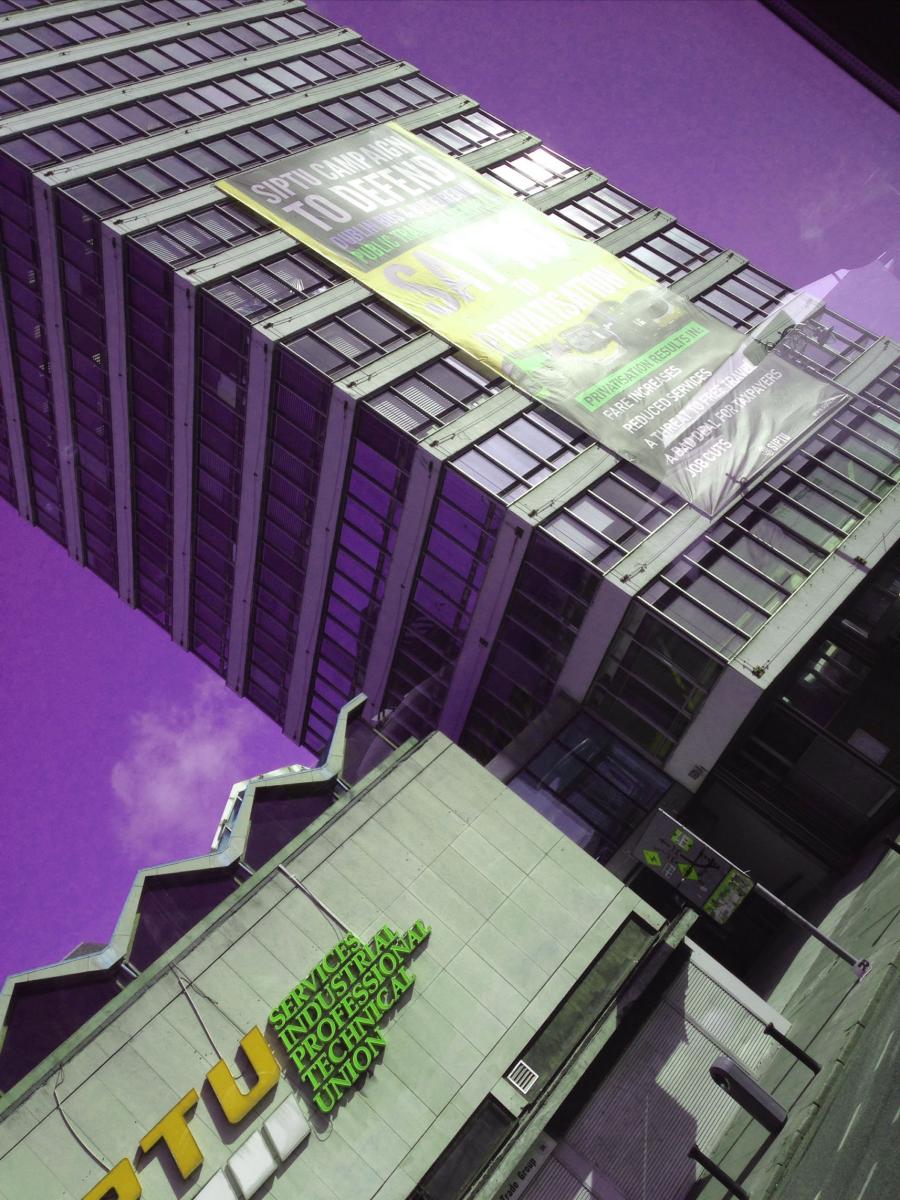 As the trade union leadership does its best to drag us back into a new round of ‘social partnership’, Gregor Kerr – an activist in the Irish National Teachers Organisation – compares the best and worst of recent developments in the trade unions and poses a challenge – Can we save the movement by ridding it of the stultifying bureaucracy that seems set to strangle the life out of it?
The past number of months have witnessed the best and the worst of the trade union movement and its leadership. On the one hand, the presence of 5 trade unions – Unite, Mandate, CPSU, CWU and OPATSI – in the leadership of the Right2Water Campaign has certainly contributed to its being able to mobilise some of the biggest street mobilisations in the history of the state. But on the other hand the paucity of ambition and their perspective on how change in society is brought about, sees those unions and their leaderships doing their best to drag what has been largely a community-led campaign down the well-trodden and unlikely-to-succeed electoral path.
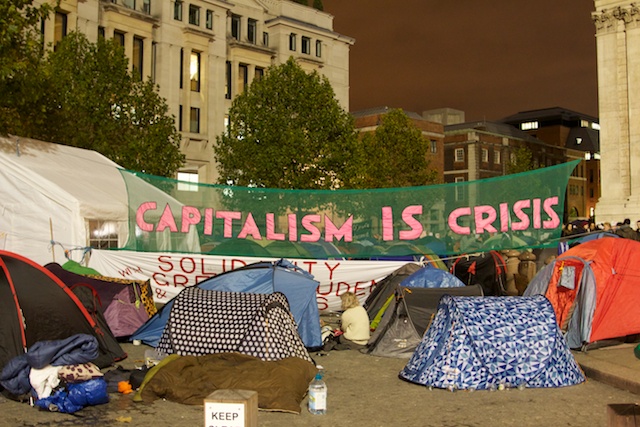 What if we build it and they don’t come? That was the experience of the left during the crisis - decades had been spent building organisations and a model of how crisis would create revolution, but when the crisis arrived the left discovered that the masses weren’t convinced. The expected pattern of crisis leading to small strikes and protests, then to mass strikes and riots and then perhaps to general strike and revolution didn’t flow as expected. Under that theory the radical left would at first be marginal but then as conditions drove class militancy to new heights, the workers disappointed by reformist politicians and union leaders, would move quickly to swell its ranks.
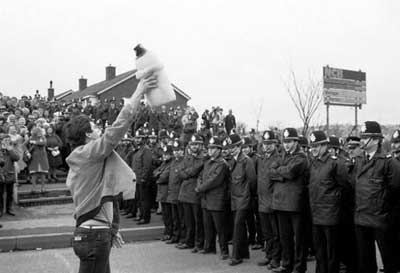 At this session at the Dublin anarchist bookfair Dave Douglass talked about his experiences of 1984 - the year the British mines almost defeated Thatcher. "That fight in 84-85 involved the whole community, it was not only about unions. It was partly about unions but it was about an industry, it was about a way of life. The miners were almost an ethnicity, with father to son for hundreds and hundreds of years in the same miner family. And we had a very strong revolutionary and radical tradition. So, all of the politics of power, fuel power was about political power and not just about energy. It was about more than that. It was about "Who rules ?""
