
Over 30 years of anarchist writing from Ireland listed under hundreds of topics
This is a series explaining the 9 Points of Unity of the Workers Solidarity Movement - an anarchist organisation active on the island of Ireland. [Download PDF of these explanations]
The WSM regularly discusses, debates and decides on what our collective political approach is. The Points of Unity are the most basic political agreement necessary to be a WSM member or supporter. They are 9 short points which outline the anarchism the WSM stands for.
'2. We reject the idea that society can be changed through 'good people' gaining control of the power structures. This means we reject both the electoral strategy of the social democratic and green parties and the 'revolutionary' strategy of the various left groups.'
The WSM is working towards a free, equal, democratic society. We believe the only way to achieve this is by people taking their destinies into their own hands, forming grassroots mass movements, and creating new truly democratic institutions.
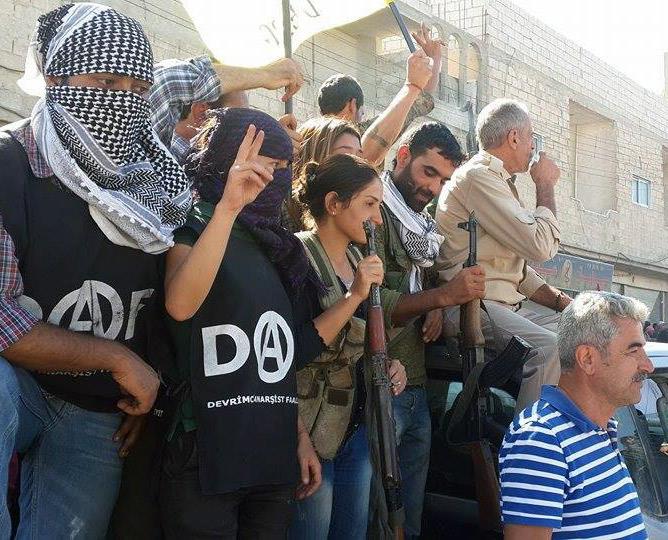 Revolutions are seldom made in favourable circumstances. Russia 1917 emerged from the mass slaughter of WWI and the disintegration of an economy under the pressure of the supply demands of that war. Spain 1936 emerged from a well planned and executed fascist coup amongst a powerful military backed and armed by international fascism. Schemas for revolution that depend on quiet times and plenty may well be doomed from the start.
That said it’s hard to imagine more impossible conditions for revolution than that of Rojava. A brutal civil war, 3 small areas of territory that were kept in a state of low development by the previous regime and are not even linked to each other. A fanatic army of barbaric religious extremists armed with captured looted US heavy weaponry attacking from one side, a hostile state quietly backing that army and closing its borders to the good guys on another and waiting in the wings the old regime and its long history of brutal counter insurgency. And above all this the tactical and strategic intervention of an imperialist power whose manipulations have devastated the land to the South East over a period of almost three decades.
 The National Conference of the Campaign Against the Household and Water Taxes in May made some key decisions. The ultimate objective of our campaign should be to ensure that everyone who gets involved in it can have an equal input into our decision-making. This will make for a more democratic and far more efficient Campaign which large numbers of people will feel direct ownership of. That will mean a far stronger Campaign and one capable of winning. On Saturday we distributed this text which explains the case for direct democracy as a leaflet to those attending the conference.
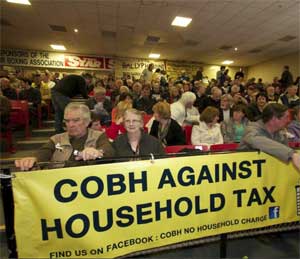 Local Participation - Get involved with your local campaign group, ensure that it meets up regularly and that decisions are made democratically and through discussion, so that people really have a sense of ownership of the campaign. This method of organising actually encourages participation, as people being asked to carry out tasks such as leafleting through an email or text message is disempowering and feels much like being given orders as opposed to a group of people working towards a common goal to benefit themselves.
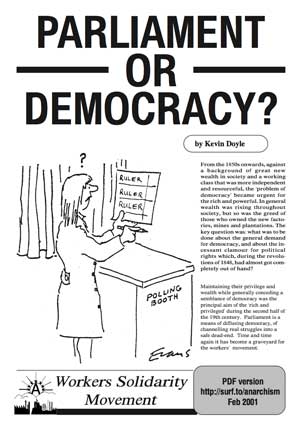 From the 1850s onwards, against a background of great new wealth in society and a working class that was more independent and resourceful, the 'problem of democracy' became urgent for the rich and powerful. In general wealth was rising throughout society, but so was the greed of those who owned the new factories, mines and plantations. The key question was: what was to be done about the general demand for democracy, and about the incessant clamour for political rights which, during the revolutions of 1848, had almost got completely out of hand?
 David Graeber’s excellent insider account of the occupation of Wall Street [1] offers us an insight into what form the politics of resistance needs to take. It will be dual purpose, having to both build resistance and also build anew. It will be about renewal, hope and learning. Crucially, how you build resistance will inform and shape what is to follow. It will entail democracy being built from ground zero.
Passed by WSM National Conference, July 2017. This sits underneath the Anarchism, Oppression, & Exploitation position paper.
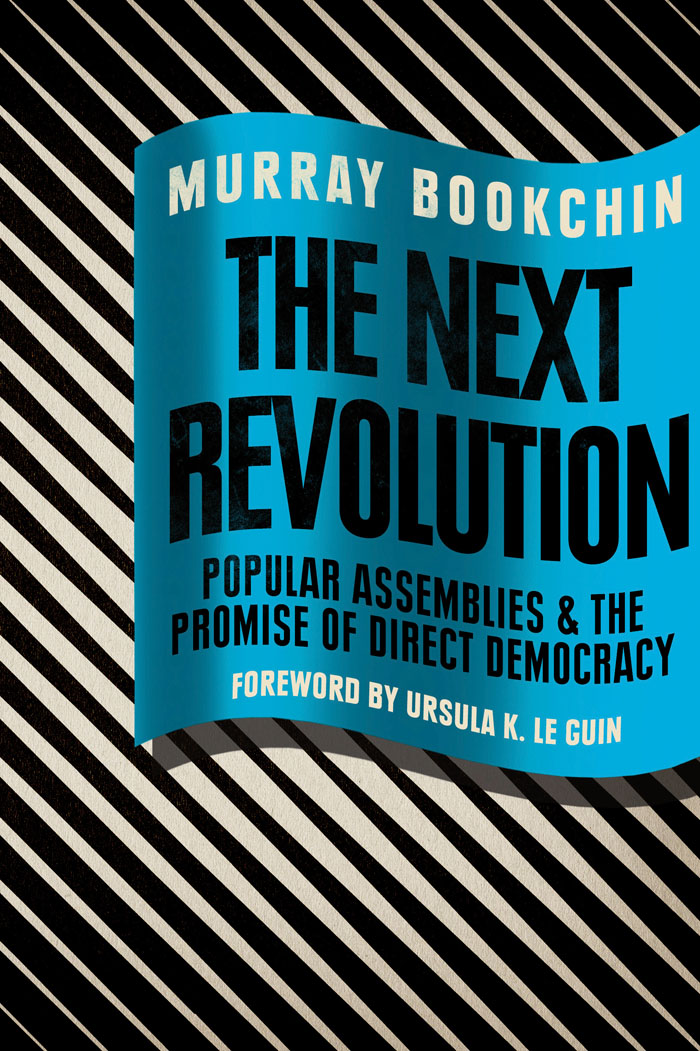 Despite being a pathbreaking figure from the 1960s onward in anarchist, green, and directly democratic political circles having predicted early on the significance of ecological issues and technology to leftwing social struggles Murray Bookchin today remains unknown to many on the left, and to those who do know of him he remains controversial.
Disliked by class struggle anarchists and Marxists for his advocacy of community organising over workplace organising, and by anarchists involved in single issue activism for their lack of organisation and supposed concern with personal rebellion over social change, he made quite a few enemies in his last days for fiery polemics directed at his intellectual opponents. While his supporters in organisations like New Compass defend him for his consistency, others argue that he ended up alienating potential allies by refusing to ever waver on his specific revolutionary vision: focused on creating a municipal confederation of ecological communities practicing direct democracy, founded on a philosophy of science, reason, and humanism.
This new collection of essays from the last few years of his life may provide a useful entry point of his philosophical and political project called social ecology and generate further debate for the future of libertarian socialist organising in an age of increasing militarism and climate crisis.
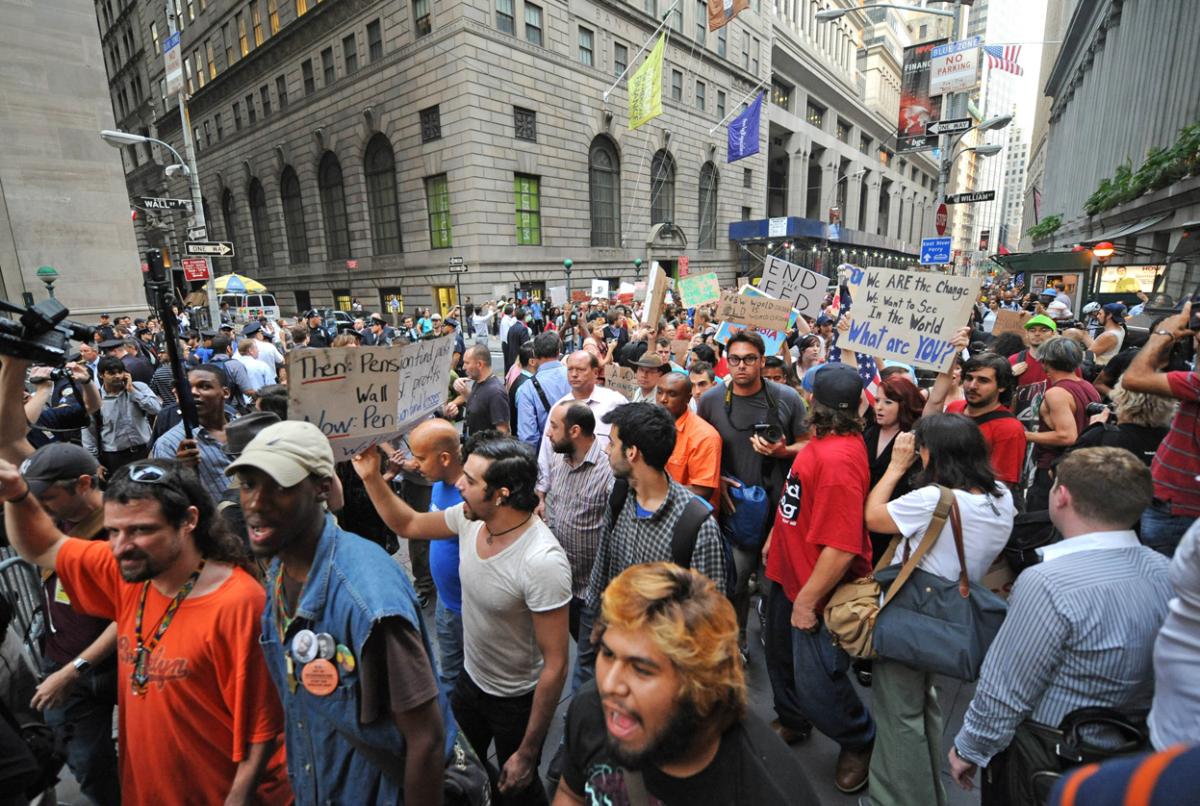 Many of us have an Occupy story. Mine took place in New York on March 17th of 2012, the six-month anniversary of the first occupation of Zuccotti Park, and the three-month anniversary of its eviction. I joined about five hundred or so Occupiers who had gathered after dark on the Manhattan side of Brooklyn Bridge. As we marched the three blocks or so to reclaim Zuccotti Park, NYPD’s finest, fully armed, literally lined the street each step of the way. And in the park itself a surveillance tower loomed overhead.