

Over 30 years of anarchist writing from Ireland listed under hundreds of topics
WSM position paper on the partition of Ireland. Last debated and updated at the April 2009 conference. It sits under the State and Democracy position paper.
Until the Real IRA blasted the heart out of Omagh and its people, the Northern "peace process" appeared to be close to achieving the impossible. Loyalists and Republicans alike signing up to the "Good Friday Agreement", its acceptance by large majorities on both sides of the border, Gerry Adams and Ian Paisley sitting down in the same room as part of the new Assembly - it seemed as if what had appeared for decades to be impossible had been overtaken by the realpolitik of the pragmatic. All sides in the "conflict" - we were led to believe - were looking to a new beginning. Countless column inches in the popular press had been written eulogising the "statesmanship" of David Trimble and Seamus Mallon, the "peacemaking skills" of Tony Blair and Bertie Ahern and the "pragmatism" of Gerry Adams and David Ervine.
The huge vote, North and South, in favour of the 'Good Friday Agreement' shows that the vast majority do not want a return to pre-ceasefire violence. Can this agreement get to the root of the sectarian problem and deal with the hatreds, fears and suspicions that have bedevilled our country? Andrew Flood looks at the prospects.
The 'Irish peace process' is now well into its second year. It has brought respectability for Sinn Féin but little of consequence for the Irish working class - North or South. Gregor Kerr a member of the National Committee of the Irish Anti Extradition Committee in the late 1980s, looks at events leading up to the cease-fire and Sinn Féin's pan-nationalist strategy.
Since the ending of the 'Cold War', many national liberation struggles throughout the world have been 'settled'. In places as far apart as South Africa, El Salvador, Nicaragua and Palestine these national liberation struggles were led by groupings which were often seen as having left leanings. However in all of these cases the 'settlement' was far from socialist. The current 'Irish peace process' is following exactly the same lines and has nothing to offer the Irish working class North or South
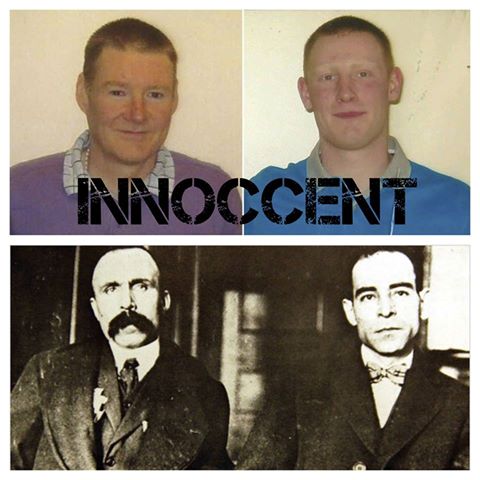 The 23rd of August marked the 91st anniversary of Nicola Sacco and Bartolomeo Vanzetti. They were both executed in the US in 1927 for the supposed robbery of a shoe factory killing of a guard and paymaster. During their trial the prosecution produced conflicting ballistic evidence and witness testimony. The defence had several witness saying where the accused men were on the day of the robbery and killings. This should have proven Sacco and Vanzetti innocence but instead both were convicted and sentenced to death. They were killed for their beliefs, they were insurrectionary anarchists “that advocated relentless warfare against a violent and oppressive government.”

 A 'shocking' report which was revealed yesterday confirmed to us what we already knew: the IRA still exists.
 Guest writer Liam O’Rourke casts his eye over the neo-liberal project of regeneration in the six counties. He notes that the elite sections of both communities have no problem uniting around what he describes as the “shared non-sectarian identity of the consumer” which reduces shared space to “commercial shared space”. Yet the fact that working class people have seen little of the promised “peace dividend” has not lead to heightened class consciousness so much as it has to increased sectarian division.
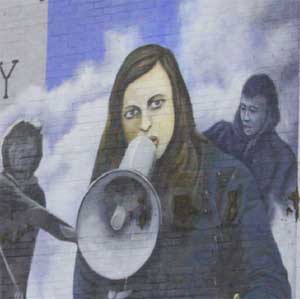 The end of the 1960’s in northern Ireland were a unique time when, as elsewhere around the world, mass popular protest emerged onto the streets with ordinary people doing extraordinary things. The unique circumstances of northern Ireland and the particular form the state backlash took there resulted in a military conflict that lasted some 30 years and dominated politics on the entire island and to a much lesser extent in Britain. Although tens if not hundreds of thousands of people made this history it can also be told as the history of some of the prominent individuals involved, including the Irish republican socialist activist Bernadette Devlin McAliskey.
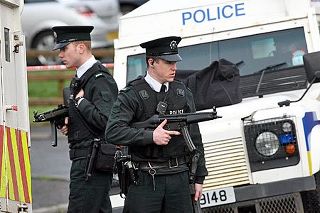 This year marks the ten year anniversary of the continuity RUC/PSNI with former Chief Constable Hugh Orde once referring to the force as the ‘most democratic, accountable police service in the world.’ However, despite the cosmetic changes and window dressing the reality on the ground in working class communities is in stark contrast to the propaganda media blitz waged by the status-quo.
