

Over 30 years of anarchist writing from Ireland listed under hundreds of topics
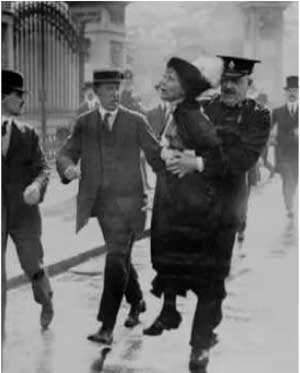 Fin Dwyer looks at the latter years of Ireland’s first post independence government, which having successfully suppressed political opposition and the workers’ movement, went on to “attack women and enforce their moral and ethical values on wider society”. From the clearing of prostitutes from the Monto and the filling of the Magdalene laundries to the institutionalisation of child abuse, he describes how the state’s close association with the Catholic Church played a decisive role in forming attitudes to women and sex that have had a devastating effect on Irish society that can still be felt today.
Workers Solidarity Movement position paper on Anarchism and Religion as ratified at November 2010 National Conference.
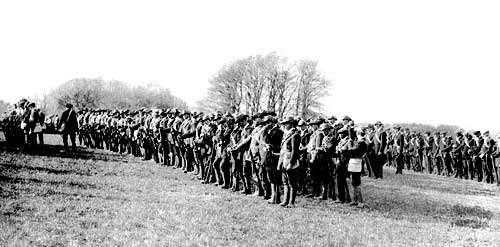 The period of Irish history from the 1880's to the 1920's defined and divided politics including socialist politics, on the island for the rest of the century. The most militant workers struggles occurred in the second half of that period, north and south, concentrated in the last five years. This was also the period of the 1916 insurrection in Dublin, the 1918-21 War of Independence, the treaty and partition of Ireland in 1921 and then in the south the bloody Civil War ending in 1923.
The year 1919 saw the greatest demonstration of the potential of Irish workers, north and south to take over the running of society but the events of the following years cemented the division that would do much to end workers militancy. In terms of working class struggle the periods of militancy of northern and southern workers coincide. Yet the working class was divided and these struggles remained almost completely isolated from each other. (Image: UVF training in 1914)
WSM position paper on the partition of Ireland. Last debated and updated at the April 2009 conference. It sits under the State and Democracy position paper.
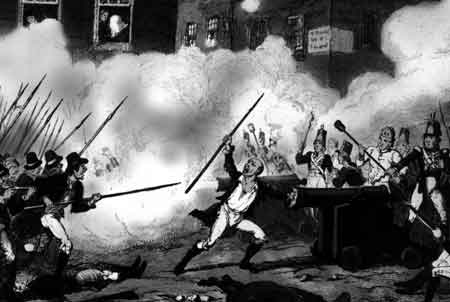 In 1798 Ireland was shook by a mass rebellion for democratic rights and against British rule. 200 years later 1798 continues to loom over Irish politics. The bi-centenary, co-inciding with the 'Peace process', has attracted considerable discussion, with the formation of local history groups, the holding of conferences and a high level of interest in the TV documentaries and books published around the event.
The huge vote, North and South, in favour of the 'Good Friday Agreement' shows that the vast majority do not want a return to pre-ceasefire violence. Can this agreement get to the root of the sectarian problem and deal with the hatreds, fears and suspicions that have bedevilled our country? Andrew Flood looks at the prospects.
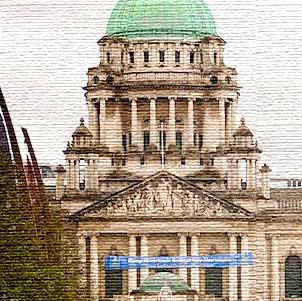 The eruption of conflict and intense rioting in Belfast over the last couple of months is a clear illustration that, no matter what lengths Stormont and the media circus go to to disguise the ugly reality of the ‘peace process’, the scars of the past and frequent eruption of sectarian conflict refuse to go away as political parties play the sectarian card to get one over on their rivals.
With over 300 police officers apparently injured so far this year, the honeymoon period following a 'successful' G8 conference has long passed - lifting the veil from a colonial sectarian settlement that has delivered a few crumbs to our class while the rich get richer. While at the same time our rulers in Stormont are busy stuffing themselves with £250,000 subsidised food expenses in 2012.
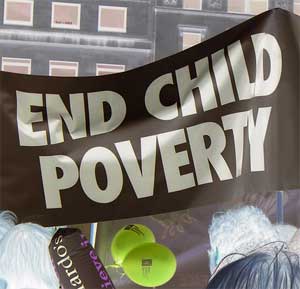 The recent report commissioned by the ‘End Child Poverty’ campaign has found that out of 650 parliamentary constituencies, West Belfast has the second highest levels of child poverty in the UK. Manchester Central being the only constituency to record higher levels of child poverty and deprivation. 43% of children within the West Belfast constituency grow up in poverty. And while this is a reduction on the previous year from 46%, other areas saw a greater percentage drop in poverty levels over that year.
Over recent weeks we have seen leaders of Nationalism call for border polls while seeing leaders of Unionism once again using a flag to whip up the loyalist working classes. This further creates division and raises sectarian tensions between Catholic and Protestant neighbours. It also diverts attention away from the issues of socio and economic deprivation, poverty, lack of social and affordable housing and the bread and butter issues of life. Yet these are the issues that day and daily affect working class communities lives the most. Politician’s words promised delivery on such essential issues of concern. And words are all that many have heard, as little change can be seen within many working class communities The old adage of ‘you can’t eat a flag’ couldn’t be more apt at this time of recession, cuts, job losses and misery for many.
In the midst of a media storm over the flag protests our local politicians have one again nailed their colours to the flag that does not distinguish between green and orange- that of capital and greedy profiteering. The proposal by Stormont minister Nelson McCausland to scrap the Housing Executive originally set up to provide fair allocation of public housing is another pillar in the ongoing savage attacks on our class.
