

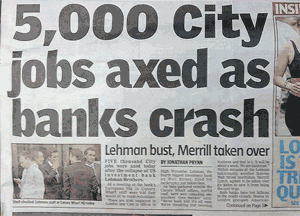
 Written months before the banking crash of the Autumn of 2008 this is the first part of a series of articles investigating the capitalist financial markets from a critical perspective. It explains in some detail what the various financial instruments are that were to be blamed for the crash and what implication they have for class struggle. (Image: Just around the corner)
With such a large topic it is tricky finding a route into the subject and a plan of enquiry. The chosen road is to start with a look at the financial markets, particularly focusing on the mechanics of some of the instruments that have led to a momentous transformation of the workings of global financial markets in the most recent decades.
At first sight, this approach may seem odd, perverse even, like examining the internal workings of a clock as a prelude to discussion the social relations of time. However this "inside-out" approach is justified by the fact that as well as a system of social relations, capitalism is also a system with internal mechanics. Those mechanics evolve in response to the historical development of struggles over exploitation, but what new directions the new mechanics make possible in terms of capitalist strategies, in turn, shape the new struggles of today and tomorrow. The next article in the series will place these market mechanics in their fuller historical context. But for now let's start by investigating the mechanics of capitalist financial markets.
Mechanics of the Markets
Commodity Markets
Commodity markets are the most direct descendants of the markets for physical goods that long pre-existed the rise of capitalism. Capitalist commodity markets are not, however, markets for all produced goods, but more specifically for either food and agricultural products or industrial raw materials. These are products that must be "commodifiable" in capitalist terms - i.e. the volume of different batches of the same good must be interchangeable in usefulness and value for all practical purposes. Such that one barrel of a particular grade of crude oil is substitutable by any other barrel available in the market. Similarly for bushels of wheat, tonnes of iron ore, coal or soybeans. Commodities are traded in Commodity exchanges, historically physically located at the major transport hubs where agricultural or raw materials were brought for onward shipment. In modern times these physical located exchanges, with their trading pits and shouting traders employing arcane hand-signals have been mostly supplanted by electronic trading systems linking office-based traders around the globe.
Capital Markets
Stocks and Shares
Capital markets are where capitalist joint-stock corporations go to raise funds for investing in their business. To do so they sell equities or stocks in their business. This is different from raising money by getting a loan in that the sale price of the equities sold does not need repaying and does not enter the company accounts as a debt - instead it is recorded as part of the company's capitalisation. In return for the money the buyer of company stock gets a part of the ownership of the company and a periodic share of the operating profits (what's left over after all costs and loan debt repayments have been made) and (usually) voting rights in the company's annual general meeting which elects the board and chief executives. There are many different types of stock which may differ a bit from the above description, but the details are not important to our investigation.
Generally speaking, buyers of stocks do so for one of three reasons. First to get income from the shares of profit regularly paid out as dividends to shareholders. Second, more rarely, as part of an attempt to get enough of the companies shares to either take it over (by getting 51% or more of all available shares) or to get enough to become a serious player in the big shareholders who get to influence the direction of the company. Finally, and the most usual motive for a lot of the day to day trading that goes on in stock exchanges, as part of a speculation of the short-term future moves of the stock price up or down.
Leaving aside speculation, which we will return to later, and governance matters, the feature of stock which most interests those long-term investors aiming to own the stock for the income from dividends, is something called the P/E ratio. This stands for the Price/Earnings ratio which is calculated by dividing the price of the share by the annual earnings its owner is entitled to. For example a share worth 100 euros which pays a annual dividend of 10 euros has a P/E ratio of 100/10 = 10, that is it will take 10 years to get back it's face value in earnings. P/E ratios, also known as the "earnings multiple" or just plain "the multiple", can vary between different industries e.g. finance vs. coal mining, due to the different periods investments take to deliver a return for practical reasons, however the average P/E ratio across all stocks in a given market is monitored closely by market watchers. If you've ever heard an analyst or news reporter talking about a marker being "overvalued", what that means is that they reckon that speculative trading on the face values of stocks has driven the price relative to earnings up to an unrealistic level. In this case they will be looking at P/E ratios much higher than the average rate predominant in the rest of the worlds markets. For example some over-exuberant speculation in East Asian markets in the 1990's drove some P/E ratios as high as over 100 - i.e. it would have taken over a hundred years to earn back the face value of the stock through dividends. Sure enough those markets crashed - or went through a "market correction" in the panglossian jargon of the uncritical market-fundamentalists. Currently the "rule of thumb" level for "correct" P/E accepted by the commentators is 18, substantially higher than the 10 it used to be in the 1980s.
Bonds
However a company does not necessarily want to issue more equity every time it needs a bit of extra cash. For one thing every time it issues extra equity it dilutes the share of profit due to holders of existing shares as well as pushing their face value down - a good way to piss off all your shareholders if you do it too often. For another reason, needs for extra money can often be for temporary measures, ranging from sums needed for a few extra months to cover, for e.g. temporary increase in operating costs due to rise in input costs, to a few years for projects like opening a branch in a new company or whatever.
One option for credit is to go to a bank or other financial lender and take out an overdraft or loan like an ordinary punter. However, another option that large and established companies have, one certainly not open to the ordinary individual, is to issue debt securities or bonds. These are effectively IOUs due to be redeemed in full at some fixed point in the future, called the "maturity" date for the full amount of the face value or "principal". The company who issues the bond is the borrower, the buyer of the bond is the lender. In addition to the promise to repay the principal on maturity the issuer also agrees to pay regular interest payments to the bondholder. Bonds are freely tradeable securities and their value relates to their face value, modified by how much interest is still due to be paid before maturity (compared to other rates of interest available) modified by any estimate that the issuer may default on the bond. As well as corporations, bonds are also issued by governments, both local and national, as well as supra-national bodies such as the European Investment Bank for e.g.
The long and short of it
Having introduced our two basic categories of securities we need to look at the way traders operate in the financial markets to make money from speculating on the changes of the face-value of securities, be they stocks or bonds.
The first strategy is if a trader thinks the price of stock is going to rise over the next period, he can buy at the current spot price and wait to see if the price goes up. If the price rises, he picks a good time to sell and sells the stock for the new, higher price, taking a profit from buying cheap and selling dear. This strategy, in some ways analogous to backing a winner in betting terms, is called "going long" or taking a "long" position on a stock, for reasons that will become clearer in a minute. What are the potential losses and gains with this strategy? The maximum possible loss is the loss of all money invested if the stock should suddenly become worthless due to some catastrophe. On the other hand, unlike in betting where the maximum win is fixed at the outset, the maximum win on this strategy has no defined limit. Nothing prevents the value of the stock tripling, expanding a hundred-fold or more. It's rare but there's nothing preventing it from happening.
Similarly, just as in betting you can "pick a loser" and lay a bet - i.e. take the other end of someone backing a horse (or whatever) to win, so in market trading of stocks, a trader can "short sell" (or just "short") a stock. To do this he obtains some stock, usually by borrowing it for a limited period, (for which he pays a small loaning fee), sells it in the market, waits for the price to fall and "covers the position" by buying it back at the lower price, in time to give it back to it's rightful owner. If the stock has fallen in price then the trader pockets the difference in price as profit. Of course, the other side is that if the price unexpectedly rises rather than falling, the trader suddenly needs to find additional money to that gained by the sell, to buy back the now more expensive stock in order to return it to the lender. An important feature of this strategy must be pointed out. Because "shorting" is the inverse or "inside out" of going long on stock, the maximum loss and the maximum gain position is reversed. The maximum a trader can gain on shorting a stock is limited by the face value of the stock. However, the maximum he can lose on a short sell, is unlimited. I'll repeat that because it's important. The maximum amount of money you can lose on a short sell is unlimited.
So why is "long" called long and "short" called short? Well, because of the activities of traders (and computer programs called "bots") speculating on share price make the face value fluctuate up and down a fair amount within the trading day and over the week, people who are confident that the performance of the company or the state of the surrounding global economy, is such that their share price will rise on average over time, need to have a little patience in holding that stock for that growth to happen. They're in that position for the long haul. On the other hand, traders looking to make some money over a temporary fall in share price due to a planned company announcement expected to contain bad news, may take a short position for only a few hours, until they reckon the share price is going to start bouncing back. Having said that, the short in short selling is commonly understood to refer to the fact that the seller is in deficit to the owner of the stock, rather than the length of the time period involved. Often short sellers are actually borrowing the stocks they are shorting from people holding them as part of a long position (or for the earnings, as many institutional investors like pension funds do). At first sight this seems crazy. Why would someone owning stock that they want to rise, lend it to someone trying to make money from the price going down? Because of the different time-frames of the different positions. The holder doesn't care if the share price goes down temporarily today, as long as it has risen by the amount they're hoping for in six months time. Also the short seller has to pay them a fee for the loan, so you're earning additional income from your shares above the dividends.
One important consequence of this is that the naive hope that watching stock market crashes on the news means that capitalists in general are losing money, is sadly mistaken. Sure some individual capitalists may be taking a bath, but that downward line on the graph is the effect of other capitalists making a killing. Which ever way the market goes capitalists continue to make money and capitalism is as healthy in a crash as it is in a boom. The same, unfortunately, cannot be said for the working class, but I'm getting ahead of myself. However, for this reason, short sellers are often singled out for particular ire during market crashes as the "unacceptable face of capitalism". This "good capitalist, bad capitalist" dichotomy is completely baseless and is often cynical hypocrisy on the part of those who wish to defend capitalism in general - by implying that capitalism has an acceptable face, for example - by deflecting popular anger onto an ill-defined set of "nasty capitalists". Short selling is simply the inverse operation of taking long positions on stock, to impute a difference of moral reprehensibility on one and not the other is spurious.
Double or quits? The use (and abuse) of "leverage"
One of the effects of the gains from short selling being relatively limited, is to encourage the use of what's called leverage. Financial leverage is analogous to physical leverage. You're trying to set up a mechanism to magnify a given movement by a order of magnitude or so. This can be achieved in financial trading by a number of different means, some of which we'll look at later in the section on derivatives. One method is to borrow money to buy the shares you are planning to go long or short on. This means you may be able to multiply the shares you buy by, say, ten times what you could have afforded with your original stake. So if things go the way you predicted you multiply your gains by ten. However, if things go wrong, and bear in mind that they can go wrong by many multiples of your shares original face value in a short position gone wrong, the size of the yawning void is also ten times as bad.
Consider you start the day having spotted a stock in some third-world groundnut co-operative that got overvalued last year due to being briefly the pet project of some Hollywood starlet. Their quarterly results are due today and you're damn sure that the cold light of reality will bring their stock down from its current 100 per share. With your current stake (say half a million) you could afford to just short 5000 shares (500,000 + 100) but that only gives you a lousy 50,000 return on a 10% drop (minus equity loan charges, brokerage, capital gains, etc.) for your brilliant insight. BOoring! So you leverage your stake by ten times to short 500,000 shares. Nice one! Time for a long lunch with your fellow "masters of the universe", something involving lobster, champagne and generous helpings of Columbia's finest. You return at 3:30pm to find that during its quarterly results the groundnut people revealed that their attempts to cultivate peanuts are not going as well as hoped, but let slip that in the process of trying to plough their land they have unexpectedly struck oil. The share price has gone crazy and now sits at 600 per share. You have to cover your position by 5pm tonight, that's 50,000 shares at 600, that's, er, 30,000,000 you need to find, or 25 million (minus the 5,000,000 you made selling the 50,000 shares at a 100 apiece this morning). Uh oh...
Of course real life trading doesn't work like quite like this. For one thing there are things called stop-loss orders which will try and set a level of things going wrong that will automatically try an liquidate your position to limit your losses. Also, given the risk of unlimited losses with shorts, they are rarely taken out on their own. They're more usually part of a hedge or straddle or a component of more complicated instrument which we will look at later in derivatives. Nonetheless numerous traders have demonstrated over the years that its possible to lose a whole lot more than 25 million euros when the game goes bad. Self-styled "Rogue Trader" Nick Leeson managed to land Barings bank with $1.4 billion in debt it didn't know it owed until the discovery of that particular financial black hole killed it.
Currency Markets
Trade & balance of payments
It should always be remembered that the joint stock company, the origin of stocks and bonds, were first created to service international trade. Specifically, England invented the joint-stock company to finance it's Virginia colony in America and for the British East India Company, royally chartered to manage the trade with India and the spice islands. The evolution of financial markets then has always been alongside international trade.
International trade requires changing money from one national currency to another, this was carried out in the past by money-changers in markets and temples (religious centres have always been strategically placed on trade routes) throughout the pre-capitalist world. In the modern financial order, money-changing is carried out in an electronic, de-centred global market that never sleeps and operates 24 hours a day, every day. The full story of the historical development of the successive regimes of global financial orders will be covered in more detail in the article to follow this one, but for now we want to look at one recent feature of international currency and financial flows, the rise of the Eurodollar.
Stateless Money - the rise of the Eurodollar
A Eurodollar is a US dollar that is deposited in a bank outside of US control. In finance the prefix euro- to a currency means deposits of that currency outside of the control of the regulation or control of the state or central bank that issues that currency. It has nothing to do with Europe or the Euro currency. As well as Eurodollars there are now Eurosterling, Euroyen and even, since 1999 and the introduction of the Euro currency, the linguistically abominable, Euroeuro.
The Eurodollar has its origins in the cold war. Due to import and export business, the Soviet Union had stocks of US dollars. In the aftermath of their invasion of Hungary in 1956 they were terrified that their deposits of dollars in the states might be seized or embargoed in retribution. To avoid this they moved all of their dollars out of US jurisdiction and into European registered banks that they controlled. At this time banks around the world would only take deposits in the national currency of the country they were registered in. The Soviet-owned banks in Europe decided that they may as well put these dollar deposits to work to earn some interest, so started offering them for loan to corporations on an anonymous, no questions asked as long as you pay the interest basis. The Moscow Narodny Bank, a soviet-owned British registered bank was one of the main players in this activity and its telex address was "Eurbank" - hence the name Eurodollars. Given the amount of US dollars outside the states due to the Marshall Plan and a negative balance of payments (i.e. the US was paying more dollars out for imports than it was receiving back in for exports), the market, once established grew explosively.
The main activity in Eurodollar trading was inter-bank loans. Given the volatility of these Over-The-Counter (OTC) loans, interest rates for individual loans varied by the hour and the minute. Eventually there was a need for an average interest rate measurement and this was set up by the biggest traders of Eurodollars, who were based in London, and is known as the London Inter-Bank Offer Rate or LIBOR. More on which later.
The importance of this Eurodollar, or more generically, Eurofinance market, was that although based on currencies issued by state national banks, they were outside the jurisdiction of any state monetary body. In other words they were stateless money. The role of this state-control free money market in undermining and helping the bring down the Keynesian Bretton Woods system will be told properly in the article that follows this one. Our interest is in the impact the Eurodollar money market had on the development of financial, as opposed to commodity, derivatives. The first entirely cash-settled futures exchange was opened in Chicago by the Chicago Mercantile Exchange (CME) to trade interest rate futures in Eurodollars in 1982. Eurodollar futures are used to hedge interest rate swaps, the first of which had taken place between the World Bank and IBM in August 1981. As Eurodollar deposits are time deposits that cannot be traded, Eurodollar futures were of necessity the first futures intended never to result in actual delivery of the underlying asset.
The futures rates were set in relation to the LIBOR which has continued to this day to be the main international reference interest rate. As national currencies have their interest rate which is set by the national banks, so the stateless currencies have their interest rates in the LIBOR, set by market trading.
Derivatives and Hedges
The future is unwritten - Risk
The warning on the adverts for investment trusts always say "remember that the value of your investment may go down as well as up". This is true of all financial dealings so the twin to the capitalist obsession with profit is an obsession with risk. Risk is always linked to time, so any financial contract that involves an element of time (and they all do, otherwise there would be no need for a contract, an immediate transaction would suffice) must, of necessity, also involve an element of risk. The estimation of the probabilities of those risks and their possible size is a continuing necessity for capitalists. What's more, the search for ways to guard against those risks and putting in place damage-limitation measures to limit the impact of negative events, if they occur, is an important, and these days profitable, part of financial activity. Hedging is the process of putting in place damage-limitation instruments in case the future moves of the market turn out to be against your best hopes. Hedging is widely seen as one of those "good capitalist" or "legitimate" operations. It is usually opposed to it's evil twin, "speculation" carried out by those "bad capitalists" who are motivated solely by seeking profit at the expense of anything else. In fact, both the "good" capitalists seeking to hedge risk and the "bad" capitalists seeking to make money through "speculation" are operating in the same market, using exactly the same financial instruments and carrying out the same operations. It is also the starting point of this article that in fact all capitalists are motivated above all else by the drive for profit. But before we can discuss sensibly on the validity or otherwise of the hedging/speculating dichotomy, we must first look at the financial instruments they use to trade in future profits and risk.
The derivatives revolution
Up until the 1970s derivatives were a marginal part of capitalist financial activity, being limited mainly to guard against the risk of movements in future prices of commodities. However from the late 70s and through the 1980s a radical transformation came about. Derivatives moved out of being an adjunct to the commodities market and proliferated in every area of financial trading. Further the volume swelled enormously until it has now become by far the largest part of financial trading activity. What was a marginal activity at the periphery has moved into the very centre of the capitalist world financial system. What was a side dish has now become the main course. This rapid and radical transformation took place against the background of, and was driven by, the transformation of the regime of global financial governance from the "Bretton Woods" or Keynesian order, to the new order that we live in today, which has attracted various names such as "neo-liberalism" or even globalism. But before we can look at the meaning of the derivatives revolution and its relation to the big picture of changes in regimes of global financial governance, we must first look at the mechanics of derivatives.
Forwards
Derivatives originated from the need to protect against the risk of unpredictable rise or fall of prices of commodities, particularly agricultural commodities whose annual production and price are at the mercy of the weather and other unpredictable factors.
Consider the wheat farmer and the miller. Before sowing his fields with wheat the farmer is faced with an uncomfortable risk, what if after all his work, he finds at harvest time that the price of wheat has fallen so low that selling his wheat will not cover his overheads and cost of living? On the other side, the miller, who consumes wheat as an impute wants to protect himself against the risk of the price of wheat rising.
The solution is what's called a forward contract. At the beginning of the year the farmer and the miller make a contract for a transaction of an agreed amount of wheat at a agreed price, come harvest time. If at that later time the actual current market price (called the spot price) of wheat is lower than the forward contract then the miller is paying more for that amount of wheat, but at least he has protected himself against the risk of the price rising and, more long-term, he knows that the same farmer is going to be around to grow more wheat next year. If the price goes up then the farmer has lost the difference between the forward contract price and the spot price, but this is a small price to pay for being able to plan your annual income and have certainty of still having a farm next year.
Futures
These forward contracts have two disadvantages. First if the spot price moves substantially away from the forward price, one side of the contract is always tempted to break the contract. Secondly, there is the disadvantage of being to tied to a direct relation between the buyer and seller, tied to particular place, etc. This forces the seller to locate an individual end user before he can fix a price.
By standardising amounts, quality and places for delivery, forward contracts can be replaced by futures contracts. Futures can be bought by producers/sellers without having to worry about who the eventual consumer/buyer will be. They can be freely circulated and traded - that is to say they have "liquidity". Further, as they are a means of protecting the difference between the desired future price and the actual spot price, they can be redeemed for the cash value of that difference, independently of the actual transaction of ownership from seller to ultimate buyer.
Historically the first futures to be settled by cash rather than physical delivery of the underlyings, were the Eurodollar futures first traded in 1975 at the Chicago Mercantile Exchange. These were also the first futures on financial instruments rather than physical commodities. Chicago has played a central role in developing the new futures and other financial derivatives based on their historic role at the nexus between the agricultural produce of the mid-west and the rest of the USA and the world. The first traders in eurodollar futures had previously cut their teeth on trading pork bellies, mid-western grain and Great Plains beef.
In our example above, the farmer buys a "put" future to sell his grain at harvest time for a given price. The miller buys a "call" future to buy grain at a given price come harvest time. When that later time comes, the farmer sells his grain on the open market at whatever the current spot price is and, if the spot price is lower than his future, gets cash payment from the holder of the other side of the future for the difference (on the contracted volume of wheat). Similarly for the miller, from the other perspective.
There are other technical differences between a forward contract and a future (futures are "rebalanced" daily to stop large potential losses growing up between start and finish time, also they are guaranteed by the exchange, rather than having to seek costly redress through the courts in the case of a default on a forward contract), but the separation of the ownership of the underlying asset from the future-proofing against the risk of price change is what makes a future specifically a derivative, as we will look at later.
Options
Another disadvantage of forwards that also applies to swaps, is that both sides are bound into the transaction. Wouldn't it be nice if you could get a contract that would fix a future price for either selling or buying that would protect you against movements in price that would hurt you, but that you had the option not to go through with if the eventual spot price turned out to be better than the one you had fixed at the time you bought the contract. No surprises then that financial markets came up with a forward-type contract with this optional get-out clause called, perhaps inevitably, options. There are two types of options - "call" options which allow you the option of buying in the future at the agreed "strike" price, or "put" options which allow you to sell at the strike price. Note, however, that for these contracts to work, one side must be under an obligation to buy or sell at the agreed price if the buyer of the optional side decides to exercise his option. So in our original example above, the farmer could, at the start of the growing season, buy a put option for a price he can live with. The cost of this option is a very small fraction of the "principal" - i.e. the full amount to be paid if he exercises the put option at harvest time. That initial price is not refundable. So if the farmer gets to harvest time and finds that the spot price is now considerably higher than the strike price for his put option, he has lost the price he paid for that option, but counts it a small price not to have to sell his produce at a pre-agreed price well below the current market rate. Should the spot rate turn out to be lower than the strike price the writer of the farmer's put option or the current holder of the other end of it, if it has been traded in the meantime, is forced to buy the agreed amount of grain at the strike price and take the loss. Similarly for the Miller buying a call option.
Swaps
The other main derivative is something called a swap. Unlike futures and options, swaps did not originate from dealing in physical commodities, they are specific to financial assets. Conceptually a swap is two cash-settled futures contracts in succession. The first to set up the swap, the second to swap back to the original status quo. What is swapped here is not rare stamps, football cards or other collectors bric-a-brac, nor yet commodities, but cash payment and income streams. Swaps started in the foreign exchange markets.
For example let's take a US multi-national corporation wanting to set a branch in a new South Asian country. It needs to raise finance in the currency of the new country to hire premises, employ staff, etc. So it needs to borrow the local currency. But it has no reserves of that local currency to repay the interest on the loan. Now it could import dollars to the foreign market and buy the local currency in a forex transaction, but if that country has exchange controls stopping foreigners buying large volumes of their currency at market rates (or is trying to impose some kind of Tobin tax) then this is inconvenient. If the US company can find a company in the South Asian country that has similar but opposite needs (i.e. it wants to get a loan in the US but has no dollars for repayment) then they can set up an arrangement between themselves to each pay the other's loan repayments. Here both companies are not actually transferring ownership of anything so no forex transaction costs occur and any exchange controls or Tobin tax are evaded.
Following on from this, it's no prizes for guessing that swaps were first set up for the very purpose of multinationals evading the exchange controls under the Bretton Woods system of global governance in place until the 1970s. From these semi-clandestine origins, the abolition of Keynesian currency controls started by Margaret Thatcher in 1979, allowed the first public swap to take place in August 1981 between IBM and the World Bank, organised by Salomon Brothers.
To go through this first transaction as an example, the World Bank (which is Swiss-based) wanted to borrow a sum in Swiss francs (Sfr) and IBM wanted to borrow a similar value in US dollars (USD). They were both going to do this by issuing bonds. At home in the US IBM would have had to pay a fairly poor base rate plus 45 basis points (US treasury interest rate + 0.45%), but due to the rarity of IBM bonds in Swiss markets, was able to issue bonds there for the Sfr base rate. The World Bank could issue bonds at base rate plus 20 basis points (+ 0.20%) in Switzerland and base rate plus 40 in the States. So IBM could borrow SFr cheaper than the WB and the WB could borrow USD cheaper than IBM could. IBM issued the bonds in Switzerland and the WB in the US. IBM loaned the WB the SFr at Swiss base + 10 and the WB loaned the USD to IBM at US base + 30 bp - result being, IBM gained 15 bp and the WB 10. The net repayment was transferred between them for the life of the loans (and Salomon was paid an undisclosed amount for setting it all up).
However, despite their origins, once concocted, swaps proved to be altogether more potent than anyone initially could have suspected. The types of swaps have proliferated greatly from the simple fixed-fixed interest swaps like the above into a vast diversity of instruments.
Once again, like futures and options, swaps do not require any transfer of ownership of the underlying assets they are deriving their payment flows from.
Swaps, however, bring something entirely new to the toolkit. Forwards, futures and options, particularly in the commodity markets they originated in, each remained tied to markets segregated by the underlying instrument. Futures or options in pork bellies, could only really be compared against the spot market for pork bellies. Of course you could liquidate - i.e. sell for money - you position in pork bellies and invest in futures for grain, but you couldn't rate your pork belly future against the grain spot market directly. Similarly, the old world, bonds were bonds, stocks were stocks and forex contracts were forex contracts. Now, thanks to the power of swaps, all these segregating divisions are dissolved. Swaps have the werewolf DNA that allow one type of financial security to be mutated into another directly - or have the option to swap nature by means of a "swaption", combining an option and a swap. They allow direct comparison of rates of risk, volatility and any other generic attribute to be competitively compared across markets that, until now, had no means of directly comparing themselves. Swaps are the philosopher's stone of finance capitalism that allows the direct transmutation of lead futures into gold options.
Proliferation
The four derivatives mentioned above are what's called plain or "vanilla" derivatives. In practice they are the basic building blocks which are assembled into complicated arrangements linking different derivatives in different underlyings to make more complicated instruments. There are a large menagerie of different species of these compound or "exotic" derivatives in the modern financial markets. However they can all be derived from these three basic types of derivatives and the powers they embody - the time-fixing of futures, the contingency of options and the mutability of swaps. Together the bestiary of derivatives these three have spawned have broken out of their original pens in the commodity and foreign exchange markets and spread across all financial markets. These basic tools have created a strategies going by the names of Bear Spreads, Naked Puts, Collars, Straddles, Strangles, Butterflies and even Vanilla Options, a veritable explosion of polymorphous perversity creating a new Kama sutra of financial positions.
Transformations
The transformations that have taken place from the era of derivatives as a marginal, commodity market-based phenomena, to it's current role in transforming capitalism's international financial order can be looked at in the following areas:
- Volume
- OTC, State control and Market visibility
- Price setting
- Dis-assembling
Volume
The volume of derivatives trading has exploded by factors of 50 and more in the last 15 years. From the position in the 1970s where derivative volumes were completely marginal to total world trading, derivatives now account for a large majority of the total volume of global financial trading. The largest global financial market by far, is the foreign exchange market which, at the last reckoning, does over 3 trillion dollars worth of trading every single day. Two thirds of that is derivatives. To give you some idea of scale, the total value of global international trade in goods and services in a whole year barely reaches 6 trillion dollars - a mere two days of forex trading. The entire aggregate gross national product of the Irish Republic amounts to 200 billion dollars - that's every single cent made by every man, woman and child in this country, from the richest to the poorest, in a whole year - amounts to little more than an hour and a half's worth of trading on the global forex market.
Over The Counter - Under The Radar...
In our discussion of swaps above, there was one additional difference between swap and futures and options that we have not so far mentioned. That is that swaps are overwhelmingly not exchange-traded instruments like futures and options. They are nearly exclusively arranged as what's called "Over The Counter" trades - that is, direct arrangements between the two counter-parties. Naturally this was the only way to operate in the early days of clandestine currency swaps undertaken to bypass currency controls. However, as the instrument is for transforming the payment/income stream for an agreed period, rather than hedging against (or taking a punt on) the future price movements in an underlying, it has continued to be arranged almost exclusively by direct, bi-lateral and customised agreements. Nearly 80% of all derivatives trades are OTC swaps, 75% of them being interest rate swaps. In addition to this we have to add the "off-balance sheet" nature of these arrangements. That is, that as no actual exchange of ownership is taking place, no evidence of it need appear on the companies audited balance sheets.
All of this has added up to a huge increase in the opacity of financial markets. Far from increasing transparency and perfecting "market intelligence" (a contradiction in terms, if ever there was one), the explosive growth of OTC derivatives has meant that increasingly governments, regulators, risk assessors and all market participants have less and less idea what the real exposures of other players is. This is one of the major factors in the current international banking crisis sparked by the sub-prime mortgage fiasco in the US. The actual size of the sum at risk from bad sub-prime loans is relatively small, the fear in the financial markets is a fear of the dark - no-one can see where the actual bad debt is, they just know it's out there somewhere.
Price Setting - The cart before the horse
One of the effects of derivatives trading that has been observed empirically has been the apparent inversion of the price setting relationship between spot market prices and futures prices. The conventional relationship is that the spot market ultimately determines the value of futures at expiration time. However in more and more markets the tendency is for the futures market to determine the spot market price. The causation for this role reversal has yet to be determined exactly but it appears to be an effect of the shift from physically settled futures to cash-settled ones. With the dominance of cash-settled derivatives, the ratio of volumes of physically delivered futures contracts to "paper" derivatives, where no physical delivery of the underlying asset is ever intended, has in many cases evolved to where the paper trades outweigh physical trades by ten to one or more. The amount of trading going on creates a situation similar to that of "if the mountain will not come to Mohammed, Mohammed must go to the mountain". In other words the force of derivative markets is determining the price over the struggle over the cost for production. This represents a major shift in the power of competition over future costs of production.
Interpretations
A deafening silence
Considering the scale and importance of the transformation that has taken place in the last couple of decades, there have been surprisingly few attempts to analyse its wider social implications. This becomes a little easier to understand if we look at the groups that we might have expected to carry out this analysis. On the one hand, the people with the most knowledge of the new developments in derivatives are the professional traders and dealers in these instruments. However, the interests of this group are limited to the narrow perspective of the implications for the search for profits in capitalist markets. So despite the proliferation of textbooks and courses on how to understand, price and use derivatives, virtually none of this sector have any interest in the wider social implications. The horizon of profit is a narrow one relative to the full scope of the human drama.
The academic and professional economist sectors, who from the outside, could have been expected to be interested in this question, are in practice crippled by zealous adherence to the dominant economic dogmas. According to the dominant neoclassical "perfect market" dogma, the entirety of derivatives trading amounts to a zero-sum game which has no overall value. Further that with the increasing perfection of markets, the need or opportunities for hedging or speculation will increasingly disappear. In any case neoclassical economism tends to have a knee-jerk reaction against any analysis containing the word "social" unless it's a Panglossian paean to markets delivering the best of all possible worlds. The marginalised economist critics of such pro-capitalist positivism, are equally blinkered by a slavish adherence to an orthodox Marxist dogma (not to be confused with Marx's actual contribution to the critique of capitalism which still has useful material) which states that, as exploitation can only occur in the sphere of production, the entirety of financial market operations, including derivatives trading, is in the sphere of circulation and thus can be safely ignored as either having no impact on "real" capitalist relations or being "unproductive" - an orthodox Marxist swear word meaning "something bad that should be got rid of". If the Neoclassical's position is a denial of reality on a par with the man who sailed round the world preaching that the earth was flat (true story), then the orthodox Marxist position is akin to closing your eyes, sticking your fingers in your ears and loudly proclaiming "Nya, nya, nya, I'm not listening!". In between the dominant Neoclassicals and the marginalised orthodox Marxists are the (neo)Keynesians. While not explicitly anti-capitalist, like the ortho Marxists, they are advocates of the need for state intervention and regulation to make capitalism run efficiently and with some vague concession to popular needs. However, the Keynesians have no more idea what to make of derivatives than their neoclassical or Marxist economist colleagues. If anything, they tend to follow Keynes' distinction between the "real economy" and speculative market trading, thus siding with the Marxists.
Breaking the silence
Given the lack of interest or dogmatic inability of the bulk of professional market traders and the partisans of the various economic orthodoxies, the work of trying to analyse the social implications has been left to those few economists critical or sceptical of capitalism as a force for good, but not bound by the blinkers of orthodox Marxism. Among these contributions is last years book by two Australian academics Bryan and Rafferty, referenced in the acknowledgements below, and on which a lot of the following is heavily reliant.
Ownership & Competition
Bryan and Rafferty and a number of other authors they reference, liken the recent takeover of financial markets by derivatives to the impact of the introduction of the joint-stock company in the mid-nineteenth century.
Like the current rise of derivatives, the introduction of the joint-stock company was seen by many commentators of the time as threatening the productive economy with the disruptive and parasitic effects of speculators and bringing with it the threat of volatility and new crises of instability. It was also an innovation that transformed the scale that it was possible to do business on, both in terms of capital and labour employed and distances covered, while changing profoundly the relationship between the directing of production, it's ownership and the distribution of its profits. Corresponding to this was an extension and intensification of the relations of competition between businesses and between capitalists and labour.
In a similar fashion these commentators claim that the derivatives revolution is introducing a similarly epochal change in these three aspects of capitalism. B&R label this "Three Degrees of Separation".
The first degree of separation is the separation of people from the land and the means of self-sufficiency to create a class society of individual owner-capitalists, rural or industrial, and a dispossessed class of wage-labourers. In this stage of separation, control over production and ownership of the means of production are united in the body of the "masters". Competition is primarily the direct conflict between master and "hands" over profit versus survival.
The introduction of the joint stock corporation transforms this network of relationships. The process of incorporation gives a degree of legal recognition of the business as a legal entity having rights. Ownership is now spread amongst the shareholders who have no individual rights to the property of the corporation. The direction of production is entrusted to a person demoted from the condition of being a "master" into being a mere "boss", themself an employee capable of being fired by the concerted will of the shareholders. While the conflicts between bosses and workers are equally capable of ferocity, the effect of ownership by stockholders who can compare the return of their shares in a given company, to that of a competing firm in the same industry and, if profitable, transfer funds to find the most profitable, means that competition now extends between firms within a given industry. The conflict between boss and workers is mediated by the conflicts and conditions of production in all the competing firms in that industry. Much has also been written about the possible conflicts of interests between bosses and shareholders. Shareholders may often find short-term gain in courses of action that may be damaging to the firm or even lead to its premature extinction. Similarly bosses may find to enrich themselves at the expense of the shareholders and workers. But both, to some extent, find their freedom of movement and power over the enterprise constrained by the legal recognition of the corporation as an entity with rights and the intensified conditions of competition with other players in the market.
The third degree of separation through derivatives involves a further loss of power and autonomy by both bosses and shareholders in the face of a third body, the derivatives dealers who derive profit from the performance of their corporations without having or needing any legal ownership claims at all. Further the ability of derivative instruments to relate and compare performance across different industries. The joint-stock corporation had made it easy to compare productivity and profitability between different firms in a given industry (in a given currency area) but difficult to relate the productivity of, say chalk miners with cheese-makers without selling out of the chalk mining industry and investing in the cheese business. Derivatives have evolved specifically to relate previously incommensurable activities directly, without any need for change of ownership in underlying stocks. With derivatives chalk and cheese can be compared directly and the achievements in advancing productivity in one industry can be set competitively against the other.
At this stage it must be mentioned that B&R are not proposing that these be seen as "stages" in the sense that one gives rise to, and is replaced by, the next. Although each has provided the basis for evolving the next level, each prior level continues to co-exist with the later ones. Along with the 21st century "third degree of separation" of derivatives-dominated financial capitalism, the east Asian "enterprise zone" clothing factory owners whose sweated workforce make the sportswear for the post-industrial workers of the west, are operating very clearly in the framework of the first degree. Derivatives feed off the multinational joint stock corporations they evolved to serve.
Implications for the class struggle
The Left Bereft
Ever since the fracturing of the nascent socialist movement in the late 19th century, the non-anarchist fractions of the left, despite other agreements on doctrine and methods, have been united by a common belief in the nation state as the indispensable tool for delivering socialism.
This fervent belief in the nation state as the sole possible means of our collective deliverance has given the state socialist left an huge emotional investment in denying the possibility that the power of the state to substantially limit or manage the flows of contemporary capitalism has been fatally undermined by the developments of the 1970s and 1980s. Many of them still cling to the belief that the deconstruction of the Keynesian international financial order that took place in that period was entirely the result of a purely political "neoliberal" conspiracy or coup that can simply be rolled back when truly social-democratic governments come back into power.
As we have seen in the section on interpretations above, most of these state socialists or social democrats are aided and abetted in this position in a Keynesian or Marxist (the two are in practice much closer bed-fellows than either would care to admit) economic dogmas which prevent them from even looking at the mechanics of the systemic changes that have taken place, never mind trying to analyse them.
The fact is that the Eurodollar money markets and clandestine currency swaps of the 1970s were not just attempts to get around the regulatory architecture of the Keynesian world order, they were successful attempts. Today's proponents of measures like the Tobin tax have yet to explain how they will tax operations like currency swaps or other derivatives based operations which achieve the same end as foreign currency transactions but without any actual taxable exchanges taking place. The same logic applies to the arguments of those who propose the re-imposition of Keynesian exchange controls - how to prevent them being bypassed by the very mechanisms that evolved specifically for that purpose? The state socialist dream of using the power of the capitalist state to discipline and control capitalism for the benefit of workers is definitively dead. They are a Left bereft.
But more importantly, from an anti-capitalist point of view, is that the "lost paradise" of Keynesian social-democracy that these nostalgics long to regain, was a deal based on workers accepting their place within capitalism and submitting to wage-restraint deals. It was worker's smashing of these wage restraint deals in the late 60's and 70's that drove the inflation that in turn pushed up the interest rates in Europe that sucked dollars out of the US and into the Eurodollar market. Keynesianism was not simply undermined by capitalist innovation in the area of derivatives, but by worker's struggles in Western Europe and, on a global level, by the heroic resistance of the Vietnamese people to US imperialism. We will cover this history in the next article in the series, but the point remains - will the state socialists in their turn adopt the position taken by the Western European Communist Parties in the 60s and 70s that workers must accept wage restraint "in order to build the productive forces", in the Marxist jargon? This line has nothing to offer the struggle for the break-out from the prison of capitalist social relations.
Beyond Industrial Unionism
Under the first two degrees of separation the class enemy directly visible to the struggling masses were first the masters and then the corporations with their bosses and shareholders. Even today in the anti-globalisation movement, the majority of the non-communist activists see the "bad guys" as the loathed MNCs - the Multi-National Corporations. From the beginning the analytical communist tendency was able to say that the ultimate enemy was neither the masters, the bosses, the shareholders or the corporations, but capital. Yet capital remained a theoretical abstraction only, inferred as an emergent tendency of the collective action of the actual, visible class enemies. Now with the rise of the financial derivatives capital markets, before which the corporations, even the multi-national ones, are expendable pawns, a new situation has arisen. As people witness the increasingly visible power of this new actor, they will ask us, "What is it?". We will finally be able to respond, "It is the enemy of whom we have long spoken. It is Capital made flesh". No longer an abstraction, the rise of the third power makes capital a concrete, directly visible enemy. And an enemy we can see directly, we can fight directly.
The outlook for the future of the class war
So in summary, while the state socialists may either mourn or remain in denial about the passing of the nation state as a platform for reforms to mitigate the evils of capitalism, we communists see the developments for what they are. We see that we will need increasingly to link our struggles across industries, across borders and across identities. That with the increasing impossibility of fighting for reforms and half-measures, we will be forced more and more to confront a newly visible capitalism itself directly. Then we must say, without under-estimating the likely savagery of some of the struggles to come, that this is a most excellent development.
Acknowledgements & References
To try and properly footnote and reference the above text would have been too intrusive for what is, after all, not an academic text. Nonetheless some acknowledgements and references are both proper and handy as guides for further reading.
For general "unpolitical" reference material on financial markets (and much of the glossary) I have made extensive use of the open source Wikipedia (en.wikipedia.org/wiki). In the category of copyrighted but freely available on the web material, I must also mention the extremely well-informed and lucid www.riskglossary.com. For pure statistics the Bank for Internation Settlements (BIS) produce the best available estimates of derivative volumes (www.bis.org) and the OECD (www.oecd.org) are good for general global financial statistics.
In the category of works contributing to a critical and political perspective, as already mentioned above, the best book available is "Capitalism with Derivatives", Dick Bryan & Michael Rafferty, Palgrave Macmillan, 2006. I would particularly also like to acknowledge the influence of the work and generous aid of my comrades Dave Harvie and Massimo de Angelis, many of whose texts on this and related topics are freely available at www.thecommoner.org.
Some Figures and Statistics
Global equity capital $51.2 trillion (wikipedia: Reuters March 2007) $165 trillion "total traded securities" (Economist, 19/01/2008)
Global physical trade
Daily ForEx trade volume $3.2 Trillion (BIS 2007)
Total Derivatives Nominal $516 trillion (BIS 2007)
Total Derivatives Value $11.1 trillion (BIS 2007)
Total Swaps Nominal $408 trillion, 79% of all derivatives
% Interest Rate Swaps 75 (BIS 2007)
First published in Red and Black Revolution 14 March 2008
